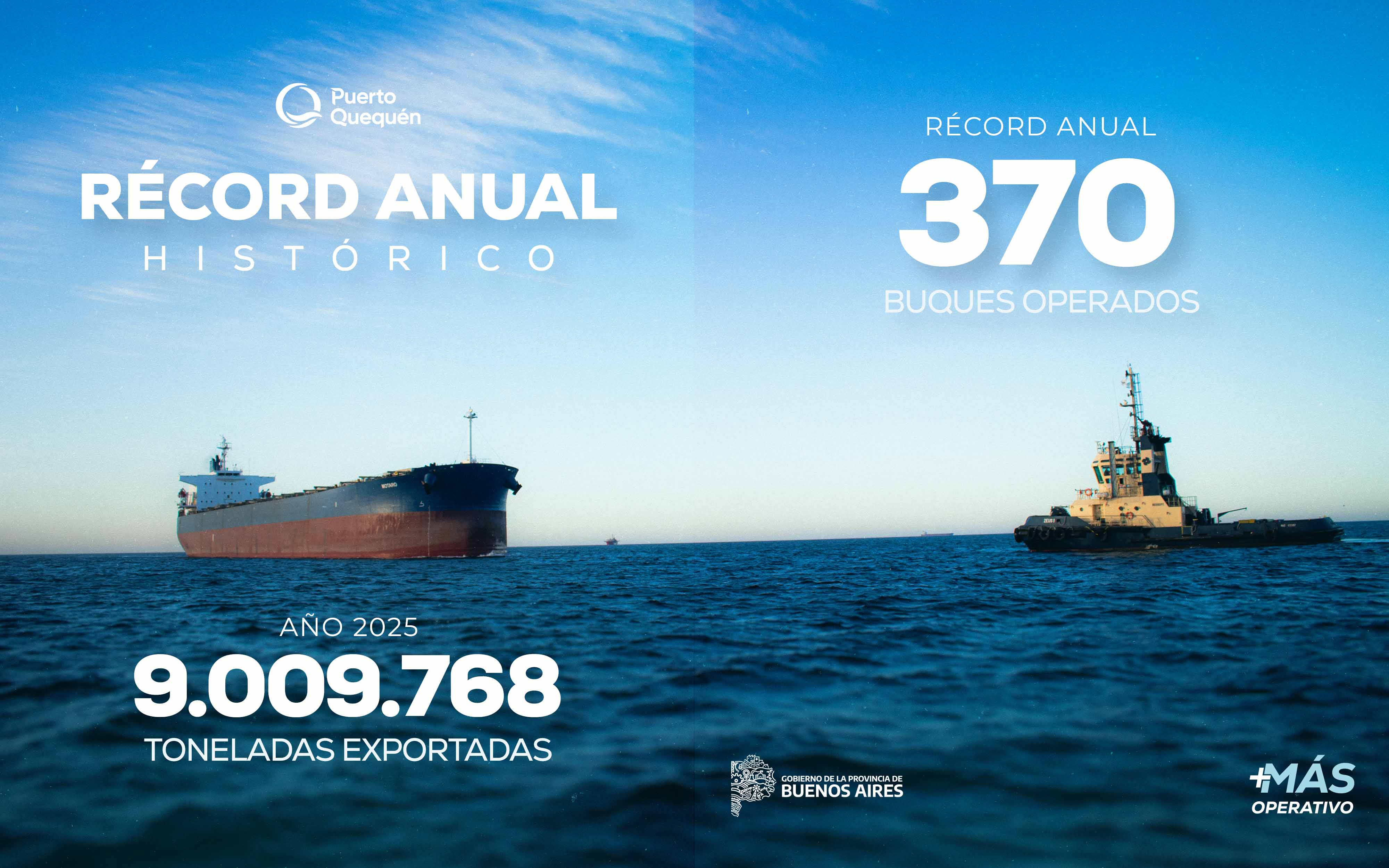
We ended 2025 with the highest cargo volume in its history, reaching a total of 9,009,768 tons handled, a record figure since operations began.
This result reflects sustained growth, based on regular operations throughout the year, high port security standards, logistical predictability, and the system’s capacity to handle large vessels continuously and efficiently.
Maritime Traffic and Operational Parameters
Between January 1 and December 31, 2025, 370 vessels entered our port, with an average length of 208.45 meters, confirming the trend toward larger ships.
- Longest recorded length: 235 meters
- Greatest draft: 44.10 feet forward and 44.11 feet aft
These parameters demonstrate optimal navigability, channel maintenance, and a reliable operating environment that allowed for operations with full holds, without the need to complete cargo loading in other ports.
Monthly Cargo Movement: Regularity and Predictability
One of the key aspects of the record-breaking 2025 was the balanced distribution of cargo movement throughout the year, which provided predictability to the entire logistics chain:
- January: 791,774 t – 29 vessels
- February: 759,898 t – 23 vessels
- March: 501,396 t – 21 vessels
- April: 510,348 t – 26 vessels
- May: 666,167 t – 29 vessels
- June: 492,131 t – 24 vessels
- July: 866,670 t – 36 vessels
- August: 935,575 t – 44 vessels
- September: 881,244 t – 35 vessels
- October: 843,983 t – 33 vessels
- November: 991,731 t – 40 vessels
- December: 768,851 t – 30 vessels
Monthly continuity allowed for planning arrivals, loading, and departures, optimizing operational times and logistical costs.
Goods Handled: Total Volume and Annual Performance
The port’s profile was once again dominated by grains and byproducts from the agro-industrial complex, with the following annual breakdown:
- Soybeans: 2,405,507 t – 85 ships – 26.70%
- Corn: 2,044,717 t – 87 ships – 22.69%
- Wheat: 1,530,457 t – 47 ships – 16.99%
- Feed Barley: 1,295,468 t – 41 ships – 14.38%
- Malting Barley: 701,272 t – 31 ships – 7.78%
- Sunflower Oil: 363,738 t – 26 ships – 4.04%
- Sunflower Pellets: 281,824 t – 18 vessels – 3.13%
- Sunflower: 62,215 t – 3 vessels – 0.69%
- Malt: 6,830 t – 1 vessel
A steady flow of imported fertilizers, key to regional production, was also recorded:
- DAP: 92,162 t – 12 vessels
- MAP: 81,081 t – 16 vessels
- UAN: 63,389 t – 10 vessels
- Urea: 61,218 t – 7 vessels
The monthly breakdown by commodity showed consistent use of the terminals, avoiding peak periods and strengthening operational organization.
Goods Handled: Total Volume and Annual Performance
The port’s profile was once again dominated by grains and byproducts from the agro-industrial complex, with the following annual breakdown:
- Soybeans: 2,405,507 t – 85 ships – 26.70%
- Corn: 2,044,717 t – 87 ships – 22.69%
- Wheat: 1,530,457 t – 47 ships – 16.99%
- Feed Barley: 1,295,468 t – 41 ships – 14.38%
- Malting Barley: 701,272 t – 31 ships – 7.78%
- Sunflower Oil: 363,738 t – 26 ships – 4.04%
- Sunflower Pellets: 281,824 t – 18 vessels – 3.13%
- Sunflower: 62,215 t – 3 vessels – 0.69%
- Malt: 6,830 t – 1 vessel
A steady flow of imported fertilizers, key to regional production, was also recorded:
- DAP: 92,162 t – 12 vessels
- MAP: 81,081 t – 16 vessels
- UAN: 63,389 t – 10 vessels
- Urea: 61,218 t – 7 vessels
The monthly breakdown by commodity showed consistent use of the terminals, avoiding peak periods and strengthening operational organization.
Main Operating Companies
The total movement was led by the main companies in the agro-export sector:
- Viterra Argentina S.A.: 1,395,396 t – 15.49%
- Asociación de Cooperativas Argentinas (ACA): 1,380,642 t – 15.32%
- Bunge Argentina S.A.: 1,293,814 t – 14.36%
- Cofco International Argentina S.A.: 1,158,662 t – 12.86%
- LDC Argentina S.A.: 919,722 t – 10.21%
These were joined by Amaggi, CHS, Syngenta, Alea & Cía, Cervecería y Maltería Quilmes, Cargill, YPF, Profertil, among others.
Export Destinations: Strong International Integration
In terms of destinations, China was the main market:
- China: 2,826,982 t – 109 vessels – 31.38%
It was followed by:
- Vietnam: 1,068,763 t
- Saudi Arabia: 990,263 t
- Indonesia: 803,801 t
- Brazil: 599,869 t
- Malaysia: 542,757 t
Shipments were also recorded to Bangladesh, India, Colombia, Peru, France, Morocco, the United Arab Emirates, the United Kingdom, the Netherlands, Chile, Australia, the United States, Pakistan, among others, along with cabotage shipments to Argentina.
Port Security and Predictability: Keys to the Record
The record achieved in 2025 was made possible by a safe, coordinated, and predictable port system, with controls, operational planning, and adherence to protocols that ensured the continuity of operations throughout the year.
Safety at sea, on the dock, and in the terminals, combined with logistical predictability, allowed us to:
- maintain high levels of monthly activity,
- operate large vessels without interruption,
- meet commercial schedules,
- strengthen the confidence of shipowners and international markets.
A Historic Year and a Solid Foundation for the Future
With 9,009,768 tons handled, Puerto Quequén closed the best year in its history, consolidating a management model based on safety, predictability, and efficiency—fundamental pillars for planning new investments and sustaining the growth of the port system.
“From Puerto Quequén, we want to thank every worker, every company, operator, union, organization, producer, and the entire community who, with their commitment and daily effort, make the sustained growth of our maritime terminal possible,” stated Mariano Carrillo, Interim President of the Port Management Consortium.
He later added, “It was a year of challenges, collaborative work, and achievements that solidify Puerto Quequén as a strategic player for the productive, logistical, and social development of the region, the province, and the country. Every ton shipped, every project, and every operational improvement reflects a shared vision for the future, based on dialogue, efficiency, and environmental stewardship.”
Finally, he expressed that “looking ahead to the new year, we renew our commitment to continue strengthening an open, modern, competitive port with strong local ties, one that generates opportunities, employment, and added value for the entire production chain.”